
The Missing Element in Design Thinking
Have we got it wrong?

TLDR
Consider the “planet” as a goal of design thinking.
Just because we have good intentions and politically correct solutions to these problems does not mean we will end up with an effective product.
Instead of tackling problems directly, consider an “indirect” approach.
This was one of the most eventful weeks I’ve had in a while - discussions about the future (AI, sustainability etc.), catching up with friends, and making new friends too! I’ve had so much to process over the weekend that this piece is written a little later than usual.
What the World Needs
Last Thursday, I attended Singapore Service Design’s meetup - graced by the sharings of Belina Lee, CEO of MandaiX and Alexander Lau, Vice President of Venture Building (ST Engineering). Both shared their experiences on bringing design into their organisations - the rollercoaster-like journey that empowered them, the challenges faced, and the impact they made.
One of my favourite takeaways from this session was how Mandai Wildlife Group, looks at design thinking. Traditionally design thinking does not consider the planet where the goal is found at the intersection of ‘desirability’, ‘feasibility’, and ‘viability’. If we were to pursue this traditional short-term goal, what would become of the planet? Where do sustainability and conservation of wildlife fit in?
I’ve been learning and practising design thinking for about 4 years now but this is the first time I’ve stopped in horror to question myself. It’s a critical reality check. Thankfully Mandai actively integrates into their goal and practice that will hopefully also inspire us to play a part in conservation.
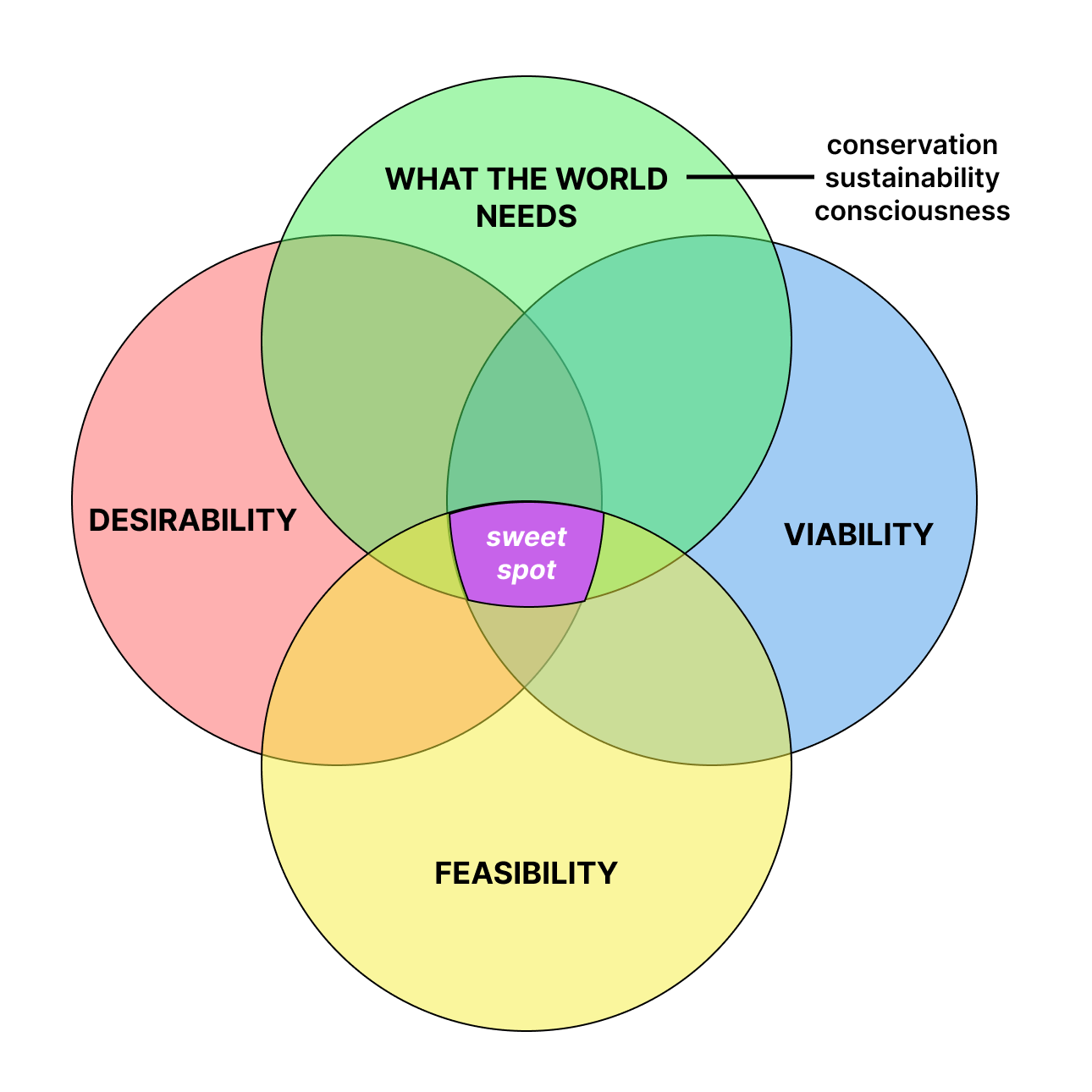
The next time you stumble upon a challenge, think about the long-term impact and sustainability of what you’re about to introduce to the world - how it would impact the environment.
On another note, when bringing design to large organisations, you’re likely to face resistance when you want to innovate. Especially if your organisation already has all processes optimised, your coming in to change things up may not always be welcomed even if it is for the greater good. But here’s what I gathered you could do:
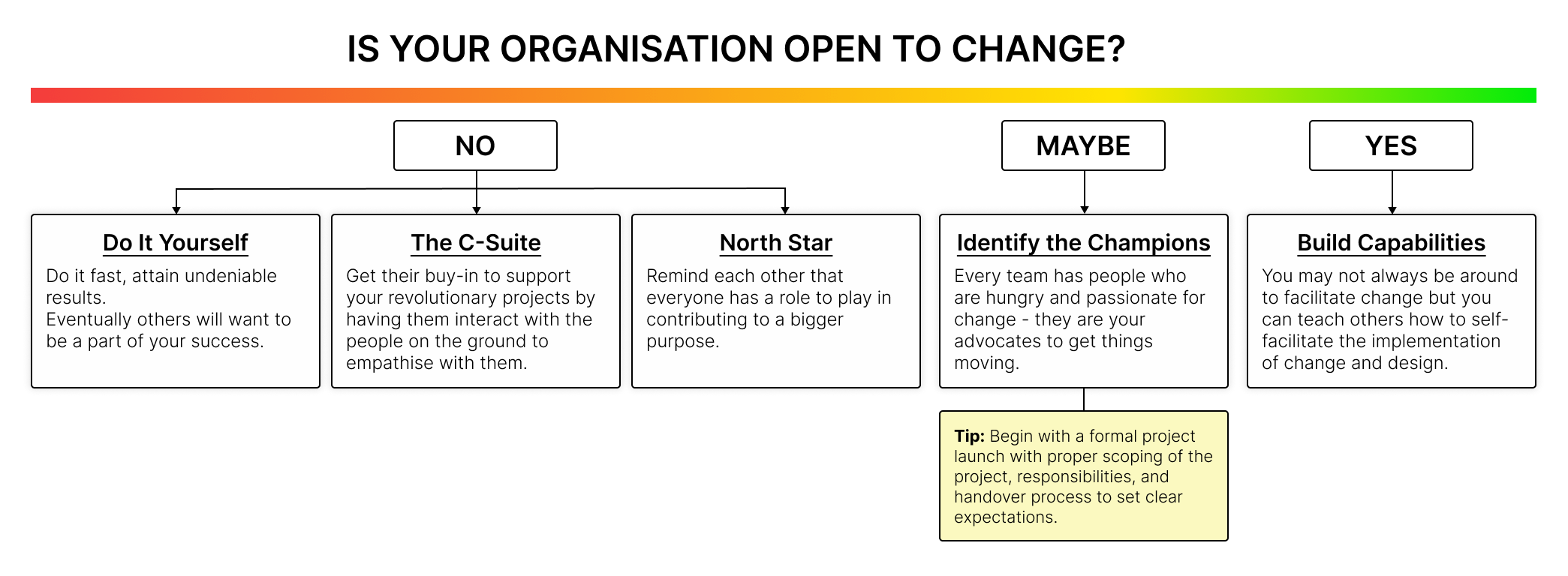
I’ve arranged the methods according to the level of resistance your organisation faces. You can definitely use a combination of methods and eventually move into a space where you look to build capabilities in your organisation for maximum impact. If you have attempted to bring design change to your company, what challenges have you faced? What worked or didn’t work for you?
Build For Good
Over the weekend, I had the opportunity to take part in Build For Good’s user testing session as a tester. The Build for Good hackathon is a month-long hackathon designed to empower citizens in Singapore to develop user-centric solutions that address pressing environmental issues. Members of the public were invited to test and provide feedback on the prototypes of the various teams.
Testing the innovative prototypes and learning about the problems the teams are passionate about was really enjoyable. While I did not get to try every single solution, I noticed a trend among the solutions I managed to play with. The majority of them incorporated the use of AI. It’s exciting to see how people integrate the use of AI into their solutions, therefore demonstrating its potential in tackling the challenges of the environment, sustainability, and conservation.
However, at the end of the session I also had this thought lingering at the back of my mind, “Just because we have good intentions and politically correct solutions to these problems does not mean we will end up with an effective product”. By ‘effective’, I meant solutions that truly change our behaviours since actions done once or twice and never again can barely make a difference. Moreover, it really is too much to expect people to fall in line with your environmentally friendly cause and adopt your solution out of goodwill. At the end of the day, the root cause is not solved because our instant gratification selves will never prioritise an impact we can’t really see.
I don’t mean to dash the dreams of the hopefully. But maybe there is another way? Try reframing the issue/problem and look at it from a different perspective. What if you create a solution that indirectly tackles the problem?
For example, a team was taking a shot at reducing food waste and their solution was to use AI to record the food (and the expiry date) by taking a photograph of the items. That would save a lot of time as compared to manually recording the details but what caught my eye was that you could take a picture of the ingredients to generate a recipe. In my mind, that sounded a lot more attractive to me.
I encounter this situation occasionally:
I have a bunch of “random” ingredients (leftovers or bought because of a good discount) that for the life of me cannot find a good recipe configuration for. Some may be used but chances are I’ll have that one or two lying around past the expiry date (aka food waste).
But this time, with the AI helping to figure out a suitable recipe for all my ingredients, I can cook and consume without the mental effort. Hopefully, reducing my food waste when I find a use for the ingredients. Of course, it’s difficult to say this will work out because it’s not tested over some time in the kitchen. Still, I would like to wonder - perhaps tackling our psyche/tapping into related behaviours/indirectly addressing the effects could become a potentially more effective solution.
What do you think?